

The Gothic Archive is a growing digital collection of late eighteenth and nineteenth-century British Gothic chapbooks held in a variety of private and research libraries in the United States, Canada, and Europe. The chapbooks have been digitized or transcribed and linked to summaries and supplemental materials. Questions related to the Gothic Archive should be directed to Wendy Fall, [email protected].
Chapbooks - Gallery - Glossary A-Z - Glossary Map
Source Materials - Supplemental Materials - Gothic Scholarship - Archive Home







-
![Almagro & Claude, or the Monastic Murder [Transcript] by Unknown](https://epublications.marquette.edu/english_gothic/1009/thumbnail.jpg "Almagro & Claude, or the Monastic Murder [Transcript] by Unknown")
Almagro & Claude, or the Monastic Murder [Transcript]
Unknown
Almagro and Claude is a direct extraction from Matthew Lewis’ The Monk, retelling the banditti inset tale and incorporating the bleeding nun narrative.
The Marquis d’Axala changes his name to Don Almagro to conceal his rank, and begins his travels. On his way to Stasbourg, he is stranded in the woods at night, and ends up staying along with the Baroness Wildenheim in a woodcutter’s hut. Tipped off by the housemistress, Antonia, Don Almagro concludes that he and the Baroness have fallen into the hands of some banditti in disguise. Using the element of surprise, he attacks in conjunction with Antonia, and defeats the leader of the banditti, successfully carrying the Baroness back to her husband. Antonia turns out to be the Baron’s long-lost daughter, and is received with open arms. The Baron promptly assigns his men to the chase, and they capture sixty banditti in the woods.While at castle Wildenheim, Don Almagro hears about Claude, the niece of the Baroness, who is about to be forced to take vows as a nun. Almagro decides to rescue Claude, and soon wins her esteem. Claude advises him to try to win the affections of her aunt, but the old lady falls in love with him instead, and he is forced to leave the castle. Claude then decides to disguise herself as the bleeding nun and affect her escape when the nun is expected to be about the castle. Almagro places her in this disguise into his carriage, which hits a tree, and he is injured. His injuries are worsened when it turns out that his companion is not Claude, but the real bleeding nun, who haunts him relentlessly. Luckily, the Bashaw (the Wandering Jew) knows how to exorcise her. Meanwhile, Claude has been forced to become a nun. Regardless, Don Almagro pursues her, they continue their affair, and Don Almagro requests a Papal Bull to free her. The situation worsens when Don Almagro finds a letter from Claude: she is with child, and fears she will be lost if he cannot rescue her from the tyrannical prioress. Faced with the papal bull, the prioress lies, claiming Claude is dead. Don Almagro doesn’t believe this, and sends his page in disguise to infiltrate the convent, where St. Urbana, spots him. As it turns out, St. Urbana witnessed the prioress poisoning Claude. After this is revealed in the public square, a mob storms the convent, and Claude’s brother Olphos storms into the cellars, wherein he finds Claude, emaciated but still alive, chained in the dark. Finally, she is reunited with Don Almagro and they can be together without impediment. The story then turns its attention to Father Clement, who is a licentious monk; it was he who got Claude in trouble with the prioress by revealing her plans to escape. Since he was wicked and in league with a devil-worshipper, he is condemned to death.
-
Cronstadt Castle; or, The Mysterious Visitor. An Original Romance.
Unknown
The Count de Cronstadt retires for unknown reasons to his remote family castle with his wife, the Countess, and daughter, Joanna. The family dwells there in complete isolation for ten years until their peace is interrupted by the arrival of a young nobleman, Villeroy, who appears at the castle while the Count is away. His servant, Martin, has been gravely injured defending his master from desperadoes. The Countess agrees to care for Martin on the condition that both men remain hidden and depart without the Count knowing of their stay. Villeroy, who has taken an interest in Joanna, is curious about the Count’s self-inflicted exile. One night, a ghost-like figure appears before Villeroy and leads him to an underground vault. When he relates the incident to Martin, his servant becomes convinced the Count de Cronstadt is a murderer. The two men are interrupted by the Countess, who enters the apartment in tears and leads Villeroy to her husband, who is dying from a self-inflicted stab wound. Before he dies, the Count takes Villeroy’s hand and begs his forgiveness. The Countess explains to Villeroy (who is actually Henry, the Marquis Mont Aubin) that before his suicide, the Count confessed to having kept Henry’s father locked in the castle for the last ten years. Remembering his mysterious visitor, Henry returns to the underground vault and discovers a cellar containing his emaciated father. The entire party sits down to hear the contents of a confession left by the Count. Years before, he was good friends with the elder Marquis and Chevalier Lannoy, until the Count fell madly in love with Lannoy’s wife, Julia. The two began an affair while Lannoy was abroad and Julia became pregnant. The Count conspired with a servant, Rodolpho, to murder the chevalier on his return journey. The elder Marquis eventually discovered the affair and the Count imprisoned him to maintain the secret. The Count was finally driven to suicide when he learned Rodolpho, under torture, had recently confessed his part in the murder. The chapbook concludes with Henry and Joanna’s marriage.
The appended short story, The Unfortunate Victim, is the tale of Ludovisio Carantani, who has two daughters. In a bid to consolidate his wealth, he decides to place his daughter Olympia in a convent, while the other, Victoria, is to marry a wealthy young man. He threatens to kill Olympia if she does not take the veil at his command. She begs him to release her from confinement at the convent, since she longs to enjoy her youth. In the end, she hangs herself in the convent’s garret before her vows are complete. Her father is dragged to death by his horse immediately thereafter. Victoria’s intended husband abandons her, and Victoria dies from grief.
-
Eliza, or the Unhappy Nun: Exemplifying the Unlimited Tyranny Exercised by the Abbots and Abbesses Over the Ill-Fated Victims of Their Malice in the Gloomy Recesses of a Convent. Including the Adventures of Clementina, or The Constant Lovers, a True and Affecting Tale.
Unknown
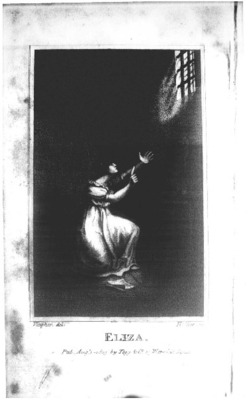
The tale of Eliza is framed by an unnamed narrator, a British man who traveled France during the French Revolution. A convent, said to be run by a strict abbess stood on a hill near the village, and he heard rumors that an Englishwoman had been kept there. As the narrator prepared to return to England, insurgents came to the village, burning the convent brutalizing the nuns, and murdering the abbess. Though the narrator is sympathetic to King Louis XVI and the French aristocrats whose homes were looted, he believes that the cruel abbess deserved her fate. While exploring the burned convent, he finds a manuscript by Eliza, an English nun. The remainder of the chapbook is Eliza’s first person narrative, written three decades before being found, which describes her upbringing as the child of a fanatical Roman Catholic father and nurturing Protestant mother, who gave Eliza a Protestant education despite her father’s insistence that his children be raised Catholic. Upon hearing that Eliza favored the “established religion,” her father sent her to the French convent. Eliza submitted, but was determined to escape from the despotic abbess and the convent if given the chance. She befriended a French nun, Sister Madeleine, and falls instantly in love with one of her relations, Charles de R…, with whom she communicated through secret letters. Eliza planned to escape, but the abbess found her letters and had her confined to a dungeon for life where she was denied adequate food. She penned the narrative for her father, then slit her own throat and died in Madeleine’s arms.
-
![Ethelred & Lidania; OR, The Sacrifice to Woden [Transcript] by Sarah Scudgell Wilkinson](https://epublications.marquette.edu/english_gothic/1013/thumbnail.jpg "Ethelred & Lidania; OR, The Sacrifice to Woden [Transcript] by Sarah Scudgell Wilkinson")
Ethelred & Lidania; OR, The Sacrifice to Woden [Transcript]
Sarah Scudgell Wilkinson
The story is set in the medieval period and begins with Sir Ethelred, a superstitious but tolerant pagan knight, caught in a storm at sea with his Christian tutor and friend, Aribert. He was returning from a visit to a Count’s daughter, who his wealthy but overbearing pagan father wanted him to marry. Desperate to survive the storm, he invokes the Saxon god Woden to save him, promising to sacrifice the first person to greet him at his home. The weather calms, and Ethelred returns home. Happy to have survived, he immediately greets his wife. He quickly remembers his vow and starts off to his father’s house the next morning, determined to bring the matter to the priests of Woden. Upon arrival, he finds his father dead on a funeral pyre. Ethelred inherits his father’s estate and becomes the Baron. He then goes to consult the priests of Woden, who declare that Lidania can live if she renounces her Christian faith. She refuses, and prepares to be sacrificed for Ethelred’s vow. Upon seeing this, Ethelred converts to Christianity and declares that he would sacrifice himself with his beloved wife. Right before they are killed, Lidania’s brother Lucius arrives with a declaration from the sovereign, a convert to Christianity, prohibiting human sacrifices to Woden. After Ethelred’s conversion, most Saxons in Britain convert, and he and Lidiana live to see their granddaughter married to the King of England.
-
Fatal Jealousy; or, Blood Will Have Blood! Containing the History of Count Almagro and Duke Alphonso; Their Combat in the Dreadful Tournament and the Death of the Beautiful Bellarmine, Through the Artifice of Sophronia, Her Rival
Unknown
Fatal Jealousy opens during a Spanish campaign against the Moors. Count Almagro, a Spanish knight, is spared during combat by an old African prince, Razallah. Almagro later returns the favor by pledging to protect a dying Razallah’s daughter, Almora. The two are married, despite objections to the bride being an infidel, and Almora turns out to be the daughter of a Spanish couple imprisoned by a licentious Moor. Upon their return to Spain, Almagro and Almora retire to the country. Their only daughter, Sofronia, is betrothed to Alphonso, Duke of Tenedos. While in Madrid for a tournament, Alphonso falls in love with the daughter of a goldsmith, Bellarmine. Upon learning of Alphonso’s marriage to Bellarmine, Sofronia and her father swear revenge. Almagro challenges Alphonso to a duel, during which Alphonso decapitates Almagro. A guilt-ridden Alphonso decides to join the crusades as penance for killing the count. Before he leaves, Alphonso entrusts his faithful hound, Fidelio, to Bellarmine’s care and claims that keeping the dog with her at all times will be an assurance of her fidelity. Upon learning this, Sofronia enlists a monk to steal Fidelio from Bellarmine. Bellarmine sets up a tent at nearby crossroads in order to ask knights returning from the crusades to seek Fidelio, but Sofronia, disguised as a knight, intercepts Alphonso and convinces him of Bellarmine’s adultery. Alphonso kills Bellarmine in a fit of jealous rage and dies of grief a year later.
-
Father Innocent, Abbot of the Capuchins; Or, the Crimes of Cloisters
Unknown
Father Innocent draws large crowds to his sermons due to his famous purity. Among them are Drusilla and her fifteen-year-old niece Ambrosia and two cavaliers, Olmas and Antonio. The four meet in the congregation and form friendships as Antonio seeks to woo Ambrosia. Among Innocent’s followers inside the monastery is his favorite novice, Philario, who turns out to be a woman named Sabrina in disguise; she is a seductress in league with Lucifer, and has come to bring about Innocent’s downfall. She successfully seduces Innocent and traps him with the need for secrecy. Meanwhile, Antonio’s sister, Bertha, is a nun in the nearby Convent of St. Clare. Bertha is pregnant and in love with the Marquis di Langara; she hopes to escape the abbey to elope with him. Father Innocent discovers their scheme and reports Bertha to the abbess, who punishes her by locking her in the crypts and leaving her to starve. Meanwhile, the bored Father Innocent shifts his sexual interests from Sabrina to the lovely teenaged Ambrosia. Father Innocent joins Sabrina in a dark ritual to summon Lucifer, who provides him with the magical means to rape Ambrosia in her sleep without her knowledge. Leonora, Ambrosia’s mother, walks in during his attempted rape, and to cover his crimes, Innocent kills her. In the meantime, Antonio and the Marquis have attempted to rescue Bertha from the convent, but discover her missing. They confront the Abbess in the city square and accuse her of Bertha’s murder, starting a riot. While defending the terrified nuns during the riot, Antonio discovers his sister Bertha alive and trapped therein with the corpse of her baby. Another nun, Romalia, escapes with Bertha, and within a few weeks Romalia marries Antonio, and Bertha weds the Marquis di Langara. During the same riot, Father Innocent sneaks into the crypt and succeeds in raping Ambrosia (whom he had drugged and abducted from her home after her mother’s murder) and murders her to protect his secret. Innocent and Sabina are caught and tortured by the Inquisition. Sabina makes a deal with Lucifer to receive her freedom, and Innocent wants the same. He summons Lucifer, who reveals that Ambrosia was Innocent’s sister. In exchange for his soul, Lucifer frees Innocent, but then throws him down onto a mountainside where he dies.
-
![Horatio and Camilla; OR, THE NUNS OF ST. MARY. A TALE OF THE FOURTEENTH CENTURY [Transcript] by Sarah Scudgell Wilkinson](https://epublications.marquette.edu/english_gothic/1014/thumbnail.jpg "Horatio and Camilla; OR, THE NUNS OF ST. MARY. A TALE OF THE FOURTEENTH CENTURY [Transcript] by Sarah Scudgell Wilkinson")
Horatio and Camilla; OR, THE NUNS OF ST. MARY. A TALE OF THE FOURTEENTH CENTURY [Transcript]
Sarah Scudgell Wilkinson
Horatio, a young nobleman, is engaged to Lavinia, a young noblewoman. For the three years before the marriage, Lavinia lives in the convent of St. Mary; Horatio falls in love with Camilla, one of Lavinia's companions. Soon afterwards Camilla disappears, apparently having run away with a nun from the convent. Camilla is recaptured, and it is said that she dies; Lavinia eventually leaves the convent and marries Camilla's brother Henry. Shortly after the marriage Lavinia is called to the convent of St. Bennet, where she is reunited with Camilla, who had eloped with a disguised Horatio, been recaptured and ill-treated in the convent, and had at last escaped. Henry's joy at his sister's return inspires him to give a ball in celebration; one of the attendees of the ball seems enamored with Camilla and returns the next day to propose. She turns him down, and Henry, Lavinia, and Camilla go to Montpellier for Camilla's health. Living near Henry's Montpellier estate is a recluse, with whom Henry and Lavinia try to match Camilla; she is uninterested. As she wanders the grounds of the estate, she is kidnapped by minions of Baron de Crass, the man who was interested in her at the ball. De Crass tries to forcibly marry Camilla, but she is rescued by Henry and the recluse, who is revealed to be Horatio. Horatio and Henry kill de Crass and rescue a young man who de Crass had imprisoned. Horatio and Camilla are finally able to marry at the end.
-
Inkle and Yarico; or, Love in a Cave. An Interesting Tale.
Sarah Scudgell Wilkinson
Narcissa Curry and Thomas Inkle are informed in the beginning of the story that they are engaged to be married. In England, Thomas is happy to hear of his impending marriage, while Narcissa mourns in Barbadoes because of her love of Captain Campley. Enroute to Barbadoes, Thomas’ ship crashes in the Americas and all the passengers are killed by Indians except him and his servant, Trudge. They are rescued by the beautiful Indians Yarico and Woski. Thomas and Yarico fall in love and decide to return to England together. Two events are triggered by Thomas’s arrival in Barbados enroute to England: (1) Inkle sells Yarico to the governor whom he believes to be a slave trader in order to follow through with the marriage to Narcissa and save his family’s money and (2) Captain Campley goes to the Governor to request permission to marry Narcissa and is given it because he mistaken for Inkle as the Governor has never met Inkle or Campley. Before the wedding of Campley and Narcissa, the Governor, a slave trader to Thomas, agrees to buy Yarico from Thomas, an unknown slave peddler to the Governor. After the Governor meets Yarico, who reveals that she is pregnant, Thomas’s Uncle Medium appears and reveals that he is infact Narcissa’s true betrothed. When the Governor hears that Thomas was trying to sell Yarico because he loved her and wanted her to be taken care of because he had to fulfill his family duty and that Campley and Narcissa are in love, the Governor consents to the marriages of these respective couples.
-
![OAKCLIFFE HALL OR THE FATAL EFFECTS OF FEUDAL QUARRELS. A Tale of the Fifteenth Century [Transcript] by Sarah Scudgell Wilkinson](https://epublications.marquette.edu/english_gothic/1015/thumbnail.jpg "OAKCLIFFE HALL OR THE FATAL EFFECTS OF FEUDAL QUARRELS. A Tale of the Fifteenth Century [Transcript] by Sarah Scudgell Wilkinson")
OAKCLIFFE HALL OR THE FATAL EFFECTS OF FEUDAL QUARRELS. A Tale of the Fifteenth Century [Transcript]
Sarah Scudgell Wilkinson
Oakcliffe Hall is the home of the Lord and Lady Bellonmore and their children, Walter and Ellinor. The family is happy and generous to all until the Lord and Lady spend six weeks at court to present their son Walter, now twenty years old, and acknowledge the new queen. Upon returning home, they find that Ellinor has not fared well in their absence. Her caregivers, chaplain Lemuel Percy and governess Allicia are unable to explain the cause of her paleness and sadness, but report it began two weeks after her parents had left for court. Eventually, Lady Bellonmore notices that Ellinor sneaks out of the house each morning to meet a young gentleman. A servingwoman spies on Ellinor and finds that her rendezvous is with Lord Arthur, son of the Duke of Belgrave. Unfortunately, the houses of Belgrave and Bellonmore have been feuding, and Lady Bellonmore is terrified that if her husband were to learn of Arthur’s courtship, the feud could escalate into violence. She confronts Ellinor with her knowledge of Arthur’s courtship, and forces Ellinor to swear a holy oath never again to see him.
A short time later, on her deathbed, Lady Bellonmore reminds Ellinor to uphold her vow, threatening to return from death to haunt her daughter if the vow is broken. Distraught, Arthur swears he can never love another woman, and begins to work on a plot to see Ellinor again. He infiltrates Oakcliffe Hall’s chapel and spies on her as she is praying, then makes a sound that startles her to shrieking in terror. As she tries to flee, she doesn’t recognize Arthur in the dark, and faints. Arthur takes this opportunity to abduct her, hiding the unconscious Ellinor in the grotto, returning with horses and his henchman Arnold to flee the area and wed Ellinor. Upon awakening, Ellinor cries out for help and tries to escape. Her brother Walter arrives just in time and draws his sword in her defense. At the end of the sword fight, Arthur and Walter are both mortally wounded, and Walter’s death causes Lord Bellonmore to die of grief. Ellinor, the sole survivor, joins a nunnery and eventually becomes an Abbess. Before departing for the nunnery, Ellinor reads her parents’ papers and discovers the origins of her family’s feud with the Belgraves. Arthur’s father had disguised himself to seduce Lord Bellonmore’s sister Angeline. Angeline died in childbirth as a result of that ill-fated union, and her baby Ellinor was raised by Lady Bellonmore as her own. Ellinor then realizes that by feuding, the families were attempting to prevent her from unwittingly committing an act of incest with Arthur, who turns out to be her own half-brother.
-
![Priory of St. Clair; OR SPECTRE OF THE Murdered Nun. A GOTHIC TALE [Transcript] by Sarah Scudgell Wilkinson](https://epublications.marquette.edu/english_gothic/1016/thumbnail.jpg "Priory of St. Clair; OR SPECTRE OF THE Murdered Nun. A GOTHIC TALE [Transcript] by Sarah Scudgell Wilkinson")
Priory of St. Clair; OR SPECTRE OF THE Murdered Nun. A GOTHIC TALE [Transcript]
Sarah Scudgell Wilkinson
The Archbishop of Rouen had the ability to pardon a condemned criminal once a year. One such pardon was that of Lewis Chabot, Count de Valvé.
Intrigued by an overheard conversation, Lewis goes to the Priory of St. Clair where he witnessed Julietta reluctantly making her nun's vows. He is unable to forget her, so bribes the under gardener, Alexis, to carry letters proclaiming his passion and desire to free her from the nunnery. Julietta refuses him.
Lewis then procures a potent liquor that will, when drunk, simulate death. Julietta drinks it unknowingly and Alexis and Lewis carry away the coffin that contains her body. When she wakes, Julietta continues in her refusal of him. Since Julietta is obdurate in her refusal, Lewis makes her his unwilling mistress. One night he catches her trying to escape through the chapel in his castle and murders her as she clings, shrieking, to the altar.
Six months later, Lewis marries, but his marriage is troubled by his odd behaviour, brought on by the fact that he's being haunted by the spectre of Julietta. He is also being blackmailed by Alexis and attempts to murder him. This attempt results in his arrest and condemnation to burn at the stake. Granted the pardon by the Archbishop of Rouen, Lewis goes abroad, enters a monastery, and dies, penitent, three years later. Isabel remarries and her son grows up and marries the niece of the murdered Julietta.